Graduate Programs Overview
Degree Programs
The Department of Mathematics offers graduate programs leading to the Master of Science (M.S.) and Doctor of Philosophy (Ph.D.) degrees. The master's degree program is built around four options emphasizing different aspects of pure and applied mathematics, and mathematics useful for secondary educators. These options require a program of ten to eleven suitable courses. The Ph.D. program is structured so as to assume a background equivalent to that of an M.S. in mathematics. It requires eight courses distributed over major and two minor areas, followed by research and specialized studies culminating in an original research dissertation directed by a faculty advisor.
Research and academics
The Department currently has 24 permanent faculty members. Faculty research interests can be broadly grouped into the areas of applied mathematics (differential equations, applied analysis, modeling, numerical methods, image processing, wavelet analysis, asymptotic methods, approximation theory), discrete mathematics (combinatorics, graph theory, matroid theory, number theory, and applications) and mathematics education. Interdisciplinary research is carried out in areas such as biomathematics, network theory, data mining, and image processing. Basic course offerings include yearly sequences in real analysis, modern algebra, topology, numerical analysis, and courses in graph theory, combinatorics, linear algebra and differential equations. Courses at the doctoral level reflect both faculty research interests and the composition of the graduate student body, and regular offerings include partial differential equations, functional analysis, and discrete mathematics.
Graduate Students and Financial Aid
There are usually about 35 full-time graduate students from diverse backgrounds. Support is available for 25 graduate teaching assistantships, which currently pay about $12,000 at the M.S. level and $16,500 at the Ph.D. level, and include a full tuition waiver (about $1200 in yearly fees cannot be waived). Several research assistantships, supported by external grants, are also usually available. There are also a limited number of partial tuition waivers available for those students who are not supported as graduate assistants. Summer support is often available in the form of teaching, assisting in the computer laboratory, or, for advanced Ph.D. students, summer research fellowships.
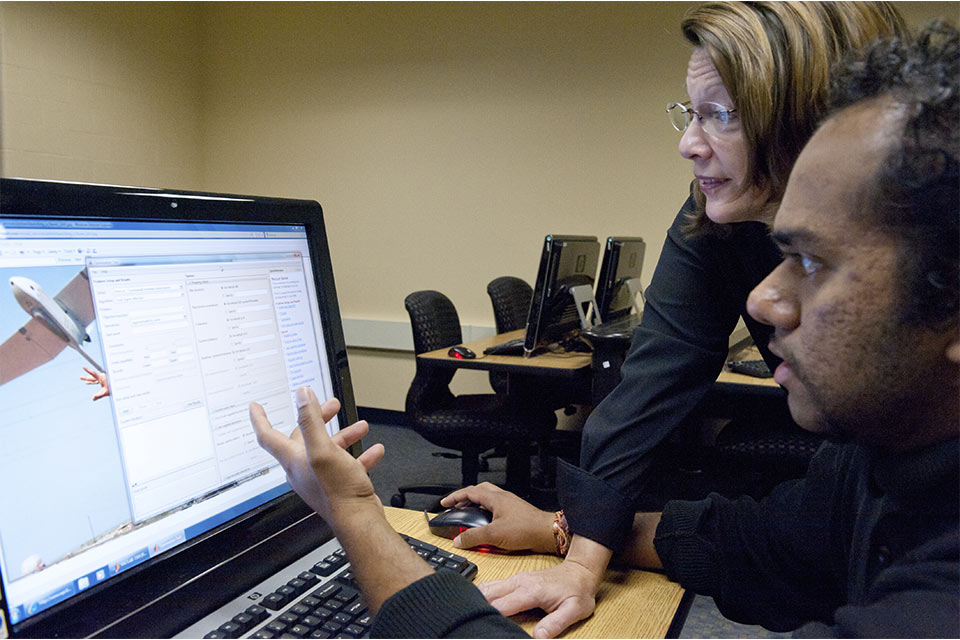
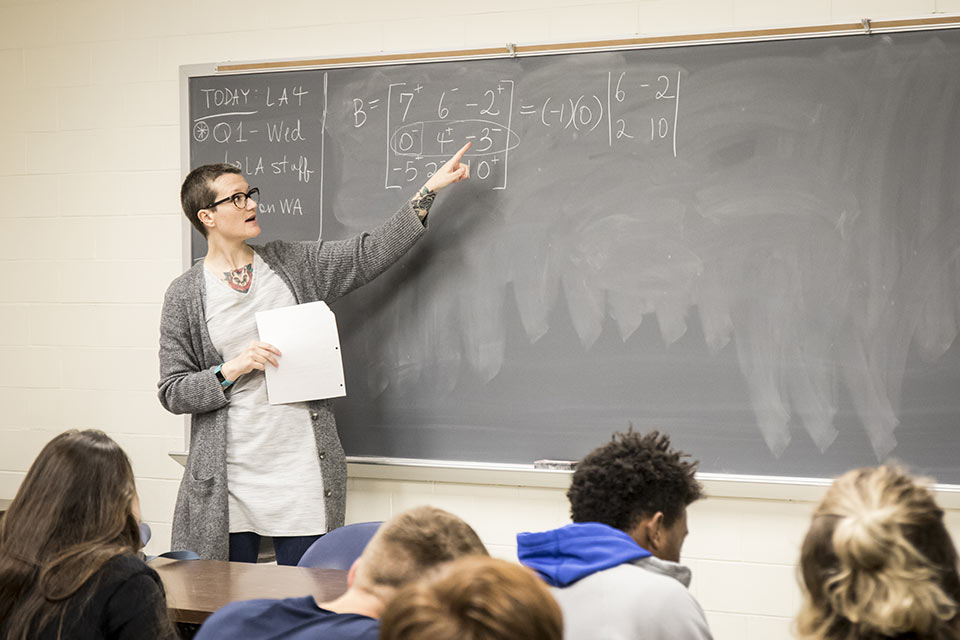
Graduate teaching assistants work under the supervision of the Department’s Institute for Mathematics Learning (IML). They participate in a year-long teaching seminar and usually begin by assisting students in the IML’s instructional computer laboratory. There is also the opportunity for teaching assistants to gain significant experience teaching their own sections in the Department’s three-semester calculus sequence or in college algebra.
Department Facilities
The Department is located in Armstrong Hall on the downtown campus. The building contains classrooms, faculty and student offices, the IML instructional computer laboratory, and additional computer laboratories for individual or classroom use. Graduate Assistants have office space equipped with telephones and networked computers. The mathematics book and journal collections are housed at the main library, a short walk from Armstrong Hall.
Environment
West Virginia University is a Doctoral/Research University-Extensive Land Grant institution enrolling nearly 30,000 students. Its comprehensive programs and facilities offer a rich cultural, scientific, and recreational environment. The University is located in Morgantown, an award winning "small'' city with a metropolitan population of about 100,000. Outdoor activities such as hiking, whitewater rafting, and skiing are all located nearby. The city is located at the intersection of interstate routes I-79 and I-68, with ready access to Pittsburgh (75 minutes) and Washington, D.C. (3.5hrs). The major cities of the Atlantic coast and the Midwest are within a day’s drive.
Further Information
For further information, and directions for applying, please see our webpage Information for Prospective Graduate Students. For a look at some information posted for current students, including our detailed Graduate Handbook, you are welcome to visit our webpage containing information for Current Graduate Students. If you wish to ask questions or need more information, you are welcome to directly contact the Graduate Director at gradprog@math.wvu.edu or via phone at (304)-293-2011.